Greetings from the Seven Sleepers
The summer in Germany is actually presenting itself in its best light. The sun is shining and, with the exception of some extremely oppressive hot days, pleasant temperatures make it possible to sit outside in the evening time. The drought means that people are less troubled by mosquitoes and other pests than in times of too much rain and dampness. At the same time, large parts of southern and central Europe have had to cope with extremely strong heat waves at times, and the lack of rain has also caused huge disruptions in river transport and energy supply because of the difficulty in cooling nuclear power stations.
As things are, it would appear that the Seven Sleepers proverb applies again this year. The German traditional saying holds that the weather which occurs on the Seven Sleepers Day (27th June), or during the days between the end of June and the beginning of July, will persist for the next seven weeks. The meteorological background to this is a general stabilising weather pattern (jet stream) over Europe at this time. In view of the continuing drought and the negative adverse effects on people and the economy, it can only be hoped that, in line with this rule, the stable, summery weather will come to an end in the second half of August and that there will be sufficient rainfall again. Meanwhile, media reporting swings between scaremongering and then a little more realism sometimes.
However, when it comes to the weak economic situation in Germany, politicians are often criticised for claiming that everything is being done badly and that all the positive aspects are no longer being recognised. Indeed, pessimism and bad attitudes do not really achieve much in regard to household and business consumer and investment sentiment, but false optimism is also wrong. For example, if politicians and also society in general do not want to see the prevailing problems, or the challenges to be faced, and so fail to take the necessary step due to a denial of realities, then reporting must become tougher and more vocal, and the consequences must also be clearly outlined.
That the climate is changing, and this is seemingly not easily stopped, is not really a surprise but is now a fact. And other regions and areas in the world prove that higher temperatures and less water can be coped with well, if the preparation is there. Germany is, however, sadly not prepared, as is the case with other problems.
Until now, despite uncertain costs and funding, the concentration has been, above all, on the prevention and containment of climate change (equated to the reduction of carbon emissions), which has involved a lot of energy and investments and (unsure) commitments to reach carbon neutrality. However – as the current heatwave in some parts of Europe demonstrates – the necessary measures to achieve greater resilience to climate change have not been taken. For example, in vulnerable facilities such as hospitals and care homes there is a lack of appropriate air-conditioning systems. Furthermore, long-standing bottlenecks on rivers, important for transport infrastructure, have still not been resolved.
For example, the important navigation channel for inland river transportation on the Rhine at Kaub, between Mainz and Koblenz, even under normal circumstances already a challenge for shipping, is now so shallow that the low water level is revealing stones and rocks, making it almost impossible for shipping to navigate this point. The Rhine has almost been divided into north and south without any connecting point in the two sections.
The tragedy of this is that this problem has long been known. After the last period of low water levels in 2018, the Federal Ministry of Transport had already announced in 2019 the action plan “Low Water Rhine”, accompanied by legislature measures. A Middle Rhine Acceleration Commission was then set up to develop ideas by mid-2023 to simplify the approval procedures. However, as far as resolving this specific and well-known bottleneck is concerned, as the current situation shows, nothing has been achieved in finding a solution.
These examples tend to show how all the good intentions of government and politicians (and to be honest also business) can quickly evaporate once the immediate pressure eases. Politicians themselves are more content in having their photos and videos taken of them visiting crisis areas and announcing ad hoc combative measures. Less interest is shown in finding an actual solution to the problems or developing resilience, which, by the way, usually costs money, and the initial momentum quickly vanishes. And then, last but not least, the domestic air-conditioning units in electrical shops are always sold out, right down to the last fan, if the heat wave continues for a few days in a row. We should take a good, hard look at ourselves.
As far as the development of the nickel price on the London Metal Exchange (LME) goes, it is just continuing as before. It is certainly not the case of the situation being clear at the moment. Unfortunately, as mentioned, the statements being made in Indonesia remain vague, unclear and contradictory, as far as they concern the adherence and implementation of lower mining quotas for nickel ores. There were recent comments, however, about quotas for a major producer being massively increased again. This immediately resulted in the nickel price, after having recovered to levels of up to USD 17,500.00/mt, once more falling to USD 16,565.00/mt. At the moment, the 3-months future price is trading around USD 16,900.00/mt on the LME. There are also no new lasting developments in regard to the Strait of Hormuz to report. A grope in the dark without any progress, whilst Iran is now aware of its position, or is at least acting accordingly in its negotiations with the USA.
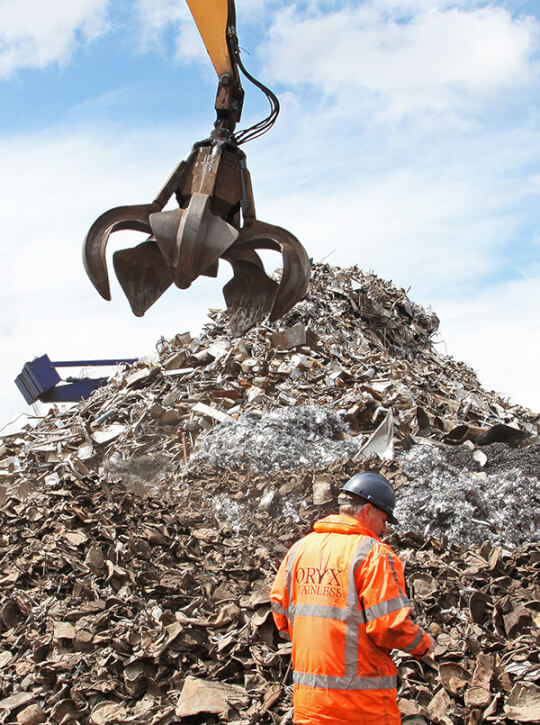
European stainless steel manufacturers are once again looking to the future with greater confidence, as, alongside a general recovery, the Carbon Border Adjustment Mechanism (CBAM) and the safeguard and anti-dumping measures, which were tightened with effect from 1 July 2026, are having an impact. The European market is being effectively protected from cheap imports from Asia, which was also necessary to create a ‘level playing field’ with fair competitive conditions. The producers’ figures for the second quarter of 2026 were therefore consistently positive to stable, as was the outlook for the third quarter of 2026. However, this does not prevent some market participants from stocking up on raw materials of dubious origin, thereby undermining their own lobbying efforts. If that ever goes well. There was already, for an example, the Audi emissions scandal. Sustainable competitiveness, resilience and the safeguarding of know-how can only be achieved with scrap metal.
Aluminium in the USA: Between investment incentives and new trade barriers
In our April edition, we reported on the high US aluminium tariffs which were supposed to strengthen the domestic market, although in reality have actually led, above all, to higher prices and additional problems for the American economy. There is now a new update: The US government has announced a new incentive programme which should encourage investments in domestic aluminium production.
Companies which build new aluminium smelters in the US, or expand or modernise existing facilities, will, in future, have their import duties reduced from the current 50 per cent to around 25 per cent. The aim is to stimulate urgently needed investment and to expand domestic production capacity in the long term.
However, the structural challenges remain. The USA currently has only four active primary aluminium smelters, whilst around 60 per cent of domestic demand continues to be covered by imports. High electricity prices and protracted approval procedures also make the construction of new smelters considerably more difficult. At the same time, the introduction of the 50 per cent tariffs, the so-called Midwest Premium – the price premium paid by American buyers compared to the world market price – caused a rise of around 1,200 to approximately 2,600 US dollars per tonne within a year. The consequences of the Iran conflict further aggravated this price rise.
It is noteworthy, however, that despite the announced tariff concessions, Washington is simultaneously planning new 50 per cent tariffs on Canadian imports worth around 20 billion US-dollars. This means that the relationship with the USA’s most important aluminium supplier remains strained. The current policy reveals, therefore, a certain contradiction: On the one hand, investment should be promoted and the supply of raw materials should be improved, yet on the other hand, new trade barriers continue to make the access to one of the most important supplier countries more difficult. It does, therefore, remain questionable whether this will actually reduce the dependence on imports.
PwC Study: Secondary steel as future model for Europe’s steel industry
The European steel industry is still facing a fundamental structural transformation. This is the conclusion of a recent study made by PwC with the heading “The End of the European Steel Industry… or simply a different one?”. On the basis of different long term scenarios, PwC examined which production routes can remain competitive by 2045, taking into account energy, carbon and transport costs. The results are particularly sobering for traditional primary steel production.
According to the PwC’s calculations, the traditional coke-based blast furnace route (BF-BOF) steadily loses competitiveness in all scenarios. The key driver is the rising carbon cost under both the EU Emissions Trading System (EU ETS) and the Carbon Border Adjustment Mechanism (CBAM). The report concludes that by the mid-2030s alternative production should already be more cost-effective, and by 2040 at the latest, the blast furnace route will no longer be the most economical option in any of the regions examined.
The assessment of PwC on the impact of the CBAM is interesting. The mechanism may indeed increase the pressure on international producers to decarbonise in their efforts to supply the European market. At the same time, however, the CBAM essentially balances the differences in carbon costs without compensating the structural disadvantages of European locations. For example, producers in the Gulf states or India can change to production processes with less emissions and profit from significantly lower energy and production costs at the same time. PwC, therefore, sees any further protection for European steel production sites as limited.
The study also identifies significant challenges for Central Europe in low-carbon primary steel production routes. High energy costs, limited availability of hydrogen and the lack of a domestic raw material base make competitive production difficult. Within Europe, only Scandinavia could produce competitive primary steel under favourable conditions in the long term. The further development of hydrogen-based production routes must, therefore, be closely followed, particularly in regard to technical feasibility, sufficient availability and the competitive cost of green hydrogen.
PwC, on the other hand, is much more positive about the scrap-based electric arc furnace (Scrap-EAF) route. Across the entire period examined, and in all three scenarios, it is one of the most cost-effective options for European steel production. Especially in Scenario 3, ‘European self-sufficiency’, secondary steel capacities are becoming particularly important: Germany would expand this, whilst imports would then play only a residual role. According to PwC, the prerequisite for this includes, amongst other things, competitive industrial energy prices as well as an effective trading mechanism such as CBAM.
The deciding advantage of the scrap route does not, however, only lie in its cost-effectiveness, but above all in the commodity’s availability and security of supply. Whilst iron ore and coking coal have to be imported, and also low-carbon primary steel routes continue to be dependent on iron ore availability, steel scrap is produced directly in Europe. Therefore, PwC describes secondary steel as Europe’s “most resilient option”. If substantial steel production is to be maintained in Europe for reasons of supply security, the study concludes that the scrap-EAF route offers the most economically viable basis.
PwC sees a challenge in the accompanying elements which accumulate during the recycling process and which can limit the properties that can be achieved with certain high-performance steel grades. In practice, however, this risk can be significantly reduced by a high-quality scrap process (note: for which, of course, a settlement would also have to be made). Consistent sorting and rejection of undesirable materials, precise material analysis and continuous quality control would enable a targeted use of suitable scrap qualities. The higher the requirements for the steel produced, the more important the quality of the upstream processing becomes. The scrap based stainless steel production in Europe can certainly serve as a blueprint here.
At the same time, the availability of high quality steel scrap will increasingly feature as a strategic factor in the expansion of EAF capacities. This is exactly a central consequence of the structural change as described by PwC: A stronger European secondary steel industry simultaneously increases the importance of more efficient recycling and processing facilities.
The PwC analysis, therefore, does not really show the end of the European steel industry but more a different future model. While the traditional primary steel production is coming more under pressure structurally, and the CBAM cannot fully counter existing locality disadvantages, Europe, with its scrap base, an established recycling infrastructure and metallurgical capability, has a significant competitive advantage of its own. “Secondary steel” could become, therefore, a central part of a competitive low-carbon, yet resilient, European steel industry.
Further details about the scenarios which were examined, and the underlying prospects can be found in the full PwC study “The End of the European Steel Industry… or simply a different one?” can be found using the following German language link: PwC-Studie 2026: Die Zukunft der Stahlwirtschaft in Europa – PwC
Africa at the centre of raw material strategy: Western countries and China are vying for new transport routes
Africa is once again becoming central in geopolitical raw material strategies. Two railway projects worth billions – one heading towards the Atlantic, the other towards the Indian Ocean – symbolise the intensifying competition between Western nations and China for access to critical minerals.
The so-called Lobito Corridor is to be modernised and expanded by 2030 at a cost of up to six billion US-dollars. A rail network of more than 1,700 km should be able to transport above all copper and cobalt from the Democratic Republic of Congo and Zambia to the Angolan Atlantic port of Lobito. The project will be financed mainly by the USA and European partners. The aim is to increase the annual transport capacity to 4.6 million tonnes and, therefore, establish an alternate route for the delivery of strategic key metals.
In the more eastern direction, the TAZARA railroad is to be modernised at the same time. The approximately 1,860 kilometre long connection from Zambia to the Tanzanian port of Dar es Salaam was built with Chinese help in the 1970s already. Now about 1.4 billion US-dollars are to be invested in order to increase the capacity to 2.4 million tonnes annually. This offers China shorter sea routes to Asia – a logistical advantage in global competitiveness for raw materials needed for energy transition and industry.
Both projects show the different approaches: While western nations rely more heavily on private operators, combined with public guarantees and partnerships, China often follows an integrated model – from exploration and mine construction to the transport and purchase of raw materials.
A prominent example of China’s long-term engagement is the Simandou iron ore project in Guinea. After western companies had failed for years to turn this into a commercial success, Chinese investment has been able to drive the project significantly forward. Up to an annual 120 million tonnes iron ore should be mined here in the future – with a clear focus on the Chinese market.
This new competition opens up opportunities for African nations, but also brings risks. Unlike in colonial times, they possess today greater trading scope in the choice of their partners. It will be decisive whether there is success in securing sustainable investment in infrastructure, jobs and government revenue – whilst at the same time ensuring fair conditions.
What is certain is that global demand for critical minerals is growing. And therefore, the pressure is increasing for Africa to act strategically clever. Whether all those involved finally do profit depends less on capital but more on political coordination and good governance.
LME (London Metal Exchange)
| LME Official Close (3 month) | ||||
| August 17, 2026 | ||||
| Nickel (Ni) | Copper (Cu) | Aluminium (Al) | ||
| Official Close 3 Mon. Ask |
16,880.00 USD/mt |
14,315.00 USD/mt |
3,272.00 USD/mt |
|
| LME stocks in mt | ||||
| July 14, 2026 | August 17, 2026 | Delta in mt | Delta in % | |
| Nickel (Ni) | 274,704 | 264,762 | – 9,942 | – 3.62% |
| Copper (Cu) | 303,525 | 207,825 | – 95,700 | – 31.53% |
| Aluminium (Al) | 284,600 | 246,925 | – 37,675 | – 13.24% |