Make Germany Great Again
It will not be managed that way in Germany. And, in this regard, Germans must, first and foremost, take a good look at themselves. Not just at their neighbours, nor at the much-maligned Generation Z. Germany does not actually have the problem of labour shortages, but it does have a problem with a lot of the work force remaining below its potential, both in terms of content and in terms of time invested. The growth of a national economy depends primarily on three factors: capital, productivity and labour. And, given that a high proportion of the economy is accounted for by the public sector, “labour” is concentrated primarily in administration and bureaucracy, so that there is an additional lack of meaningfulness and value creation. With a recalibration, real energies could be set free. But it has to be said that Germany, at the moment, has a problem with being too sluggish.
Words such as comfort zone, or indeed, laziness, should be avoided here, but the country has, quite simply, forgotten the meaning of work, and why or for whom we actually do the work. It is for one’s own personal benefit and prosperity and for the future and prosperity of the country. And this applies to companies and also administrations, to workers and also to boards of directors and entrepreneurs. Many factors, combined with the remarkable level of prosperity already achieved to date, have made it far too easy to reach personal goals set in terms of well-being and income – even with only a half-depressed accelerator, or just idling along, certainly not with the wheels spinning.
There are, of course, exceptions to the rule, but unfortunately the few who are ready to give their all are not just doing it for themselves and society in general, but also for the few who are only too happy to take things easy, slack off or let things slide. And those who do this are called in private freeloaders, hangers on, or parasites, just not in the working world. The focus for many is no longer much on gainful and fulfilling employment, but on all manner of other things, such as leave time, secondary jobs and “work-life” balance and such.
There should really be no need to explain to people that a continuance of this behaviour cannot end well. And there are certainly different, personal factors affecting stress resilience, the ability to cope under pressure or even individual productivity measured in work hours. Also, an individual’s age and the physical and mental activity carried out (both can, incidentally, be very strenuous) play a role. This should and must be taken into account of course. Those who have health issues or who have been hit hard by some of life’s other difficulties, deserve the support of society unconditionally and without reservation.
However, the prevailing ideal or the incentives provided must not serve to make life just more comfortable without having to make any effort at all. For example, it is often heard that Friday is now the new Saturday. And looking at German streets on a Friday afternoon at about 1 p.m., there is not much of an argument that can be made against this.
Also, extreme examples are circulating amongst some elderly white men and women: about the colleague who wants to apply for a sabbatical even though he has not even started the new job in the company. Or the junior manager, with a gross salary far exceeding 100 thousand Euro, who, after a 6 month training period, asks the CEO what is to be done with the 4 (in words, four) hours of overtime he has accumulated. Or the consultant taking part in a time critical project who cannot be located, but then the next day gives the excuse that from 5 p.m. onwards he takes a “digital detox” and shuts off his mobile phone.
The Deutsche Bahn (German Railways) is often reported in the media as offering up to 42 days annual holiday (a full two months) through its collective agreement model. And we have not even started to speak about the additional number of sick days prescribed by the medical profession. Even if doctors in their white coats may consider themselves to be infallible, there do seem to be grounds for doubt in this here and there, when comparing sick leave days in various countries around the world with that of Germany.
Now it would be easy to put the blame of this on employees, but, just like the migrants or stay at home fathers or mothers, they are actually only conducting themselves according to the economic rationality and theory. In trying to achieve the maximum with the minimalist of effort, if there are offers or “misplaced incentives” made, then why not make use of them. But now that so many have “taken advantage” of this, it is difficult to put the genie back in the bottle, but this has to be done, as neither state nor private finance in Germany can continue providing for all on a permanent basis.
At the same time, it would also be easy to put the blame for this precarious situation totally on the politicians, parliamentarians or public administrations. Quite a few CEOs of large corporations also carry an immense responsibility, if not indeed complicity in this miserable state of affairs. They found it in their own interests extremely good to gain favour with those in power by offering benefits to employees. This was magnified by the media. Furthermore, quite a few top managers regarded a “value-led” section of the political spectrum as a real alternative for sustainable politics. Numerous politicians of the popular parties also saw this and therefore joined less successful coalitions.
Medium sized companies, not always entirely beyond reproach, have always, however, taken a somewhat more realistic approach, such as guaranteeing a work-life balance, work from home, workation, a 35 hour week and a 35 day annual leave allowance etc., but with the tragic result that it is difficult to acquire staff on “reasonable terms”. However, when large corporations could then not take on so many school leavers and graduates, they simply became company founders themselves, or digital nomads, albeit with varying success.
In the meantime, the euphoria with large companies and politicians has dissipated again, because the so-called ordinary people, which we all are, have recognised over time that this situation of spending continually exceeding income cannot continue. At the moment, the situation is changing in the labour market and large companies are struggling, not only with international competition, but also because of the generosity of the past. Furthermore, with a lack of reforms, the electorate has turned in droves to apparent alternatives.
In conclusion to all this: on average we all have to do more, otherwise we shall have an ever-increasing debt at the expense of the younger generation which then, a little later, can get much worse. And we must also include senior citizens in some of the blame, just as much as the middle-aged and the young generation. It is just as much the truth that wealth which is being spent today rather than being invested in the future, was created by the work and drive of the senior citizens of today. And in those times, Saturday was still classed as a working day.
Giving up beloved privileges and advantages is not nice, but this has to happen and we can really do this if we really want to. And it would be better without slogans like “Yes we can” or MGGA – Make Germany Great Again. They do not help to improve the situation.
Since our last edition, nickel, on the London Metal Exchange (LME) has been quite lively, moving up and down between USD 15,400.00/mt and USD 16.400.00/mt and at this publication deadline, the 3 month nickel future was trading at USD 15,990.00/mt, so not really fully recovered. But at least a floor has been established.
Nickel between price pressure and tight supply
Lower ore and sulphur costs have improved the profitability of manufacturers of intermediate nickel products. At the same time, hefty warehouse stocks and a restrained demand continue to put pressure on the nickel market. J.P. Morgan’s Nickel Dashboard reported on the 11th November 2026 that the average LME nickel price in October was at USD 15,790/mt, five percent lower than in the previous month. Towards the middle of the month, it had reached a new year low.
The price rise which then followed was, according to the report, a result, above all, of the developments on the supply side. These included reports about possible coordinated production cuts of Chinese producers in Indonesia, as well as expectations of the restrictive Indonesian mining quotas for 2027. Since the start of this year, warehouse stocks have been increased by around 90,000 tonnes, which should ease the supply risk for consumers.
Indonesian nickel ore prices have, within one month, fallen by seven to nine percent. J.P. Morgan gives the causes as being the increase in the permitted mining quantities from 290 to 300 million wet tonnes in 2026 in the framework of the Indonesian RKAB system and also the higher ore imports from the Philippines. In the first nine months of 2026, they were 64 percent above last year’s level. This has meant that the previous tensions in ore supply have relaxed.
At the same time, the stocks in smelting plants are full, while the weak stainless steel demand is limiting additional buying requirements. For the fourth quarter, J.P. Morgan expects a continuance of low ore prices as the already available mining quotas will be used. Analysts see a possible change in trend at the publication of RKAB quotas for the first quarter of 2027. Restrictive permits and seasonally reduced deliveries from the Philippines could again reduce supplies.
Nickel pig iron (NPI) and nickel sulphate are both more or less following the downward movement of prices on the LME. At the same time, lower operational costs improved margins. According to the report, sulphur costs were around 43 percent down from the high. The margins reported in the manufacture of the nickel cobalt intermediate product, MHP, rose to more than USD 3,800/mt, even though cobalt prices fell month on month by 15 percent and MHP earnings were below 85 percent.
According to reports cited in the analysis, Tsingshan, Huayou, GEM and Lygend are considering production cuts of up to 50 percent for MHP and around 20 percent for NPI. J.P. Morgan considers that actual reductions in supply are necessary for a sustainable price recovery. At the same time, the bank expects an increase in Indonesian HPAL capacities of around 377,000 tonnes in 2027.
The market overview for 2026 in the Dashboard shows a global nickel production of around 3.805 million tonnes and a demand for 3.704 million tonnes. The surplus, therefore, has decreased from around 360,000 tonnes in 2025 to 101,000 tonnes. For 2027 and 2028, further decreases are expected of 54,000 and 26,000 tonnes respectively. Stainless steel production remains the biggest consuming sector for 2026. J.P. Morgan estimates for this sector that nickel requirements are 2.313 million tonnes, opposed to 662,000 tonnes for batteries.
Japan’s decarbonisation turns to scrap as a strategic raw material
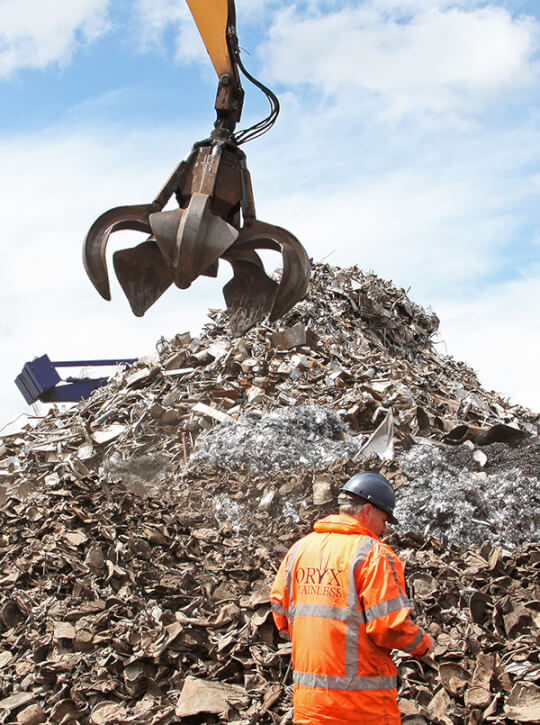
With an increasing pressure for decarbonisation in the stainless steel industry, Japan is pushing a raw material more and more into the limelight: steel scrap. While companies and government follow ambitious climate goals and, at the same time, security in supply is becoming more and more important, steel scrap is becoming a strategic part of future steel production.
An actual example of this is the new cooperation between the Japanese trading house Mitsui & Co and the recycling company Ibokin. In the first half of the year, both companies signed a memorandum of understanding, in order to improve the supply of steel scrap. Background to this is the expected expansion of steel production via electric arc furnaces (EAF), which cause significantly less carbon emissions than the classic blast furnace routes.
Mitsui brings to the partnership its global procurement network and its experience across the entire metal value chain, whilst Ibokin, as an integrated recycler, specialises in the demolition, sorting and recycling of building materials. The aim is to make the dismantling, sorting and distribution of scrap more efficient, thereby establishing stable supply chains. Exactly those issues such as quality assurance, traceability and reliable availability are becoming increasingly important for high-quality EAF steel production.
The Japanese government is also increasing its support. By 2030 public and private investment should mobilise around a total of one trillion Yen (approximately 6.3 billion US-dollar) to expand the domestic recycling capacity for metals and plastics. A central goal of the programme is the expansion of two million tonnes annually of additional processing capacity, in order to make targeted use of scrap iron in the production of high-quality steels – especially for demanding applications such as the car industry, electromobility and other segments.
However, the question remains open whether the domestic amount of scrap can keep step with the increasing demand. Japan’s recycling economy is already considered as being fully developed, while the industrial scrap amount is structurally rather on the wane. At the same time, exports are increasing: in 2025, Japan exported 7.71 million tonnes of steel scrap – almost 18 percent more than in the previous year. Above all, Vietnam and Bangladesh led to strong demand.
Parallel to this, the domestic raw steel production sank more. With 80.7 million tonnes, Japan produced in 2025 around four percent less steel than in the previous year. Yet the domestic scrap demand should rise significantly in the future. The Japanese steel association JISF expects additional requirements of around 6.9 million tonnes by 2030.
This change is particularly noticeable with Nippon Steel. The company is pushing forward with the restructure of its plant, Kyushu Works, from the blast furnace route to EAF production. At the heart of this is a large scale EAF with a capacity for around two million tonnes annually – according to the company, the first global integrated system of this size for high-quality steel production, including secondary metallurgy and continuous casting. The investment sum is over 630 billion Yen (around 4 billion US-dollar). Further EAF projects in the works Setouchi and Yamaguchi complete this strategy.
Overall, it becomes clear: Decarbonisation of the steel industry is not only a question of new technologies, but also above all a question of stable raw material supply. Steel scrap will increasingly move from being a by-product to a key strategic raw material.
Africa’s raw material moment: from supplier to industrial base?
In our August edition, we reported on the growing competition between China and the western states for Africa’s critical raw materials and the central role of the transport corridor of Lobito and TAZARA. An article by the Reuters commodity columnist, Andy Home, takes up this development, and brings, however, another important question in the forefront: can Africa use the geopolitical competition to itself profit in the future from its own rich natural resources?
The potential is huge. According to the information from the Brookings Institution, Africa possesses about 30% of global mineral reserves, but so far only realises around 10 % of global revenue from mineral raw materials. At the same time, in 2024, according to the information from the Center for Strategic and International Studies, only around 10 % of global exploration activities were attributable to the continent. With the increasing demand for copper, cobalt, manganese and other critical minerals needed for energy transition, digitalisation and AI infrastructure, this situation should change
Decisive here is that the African states no longer exclusively mind and export raw materials, but keep a big part of the value chain in its own land. The role model for this is Indonesia: when the ban on nickel ore exports was introduced in 2020, the country forced mining companies to invest in local processing capacities and subsequently became the world’s leading nickel producer. In Africa, countries such as Zimbabwe with lithium and the Democratic Republic of the Congo with cobalt and copper are now pursuing similar approaches.
However, deposits of raw materials alone do not guarantee any competitive processing. An analysis published by CRU and the World Bank points to numerous prerequisites: reliable and cheap energy, high-performance infrastructure and logistics, technical expertise, and a stable political and regulatory framework. Particularly in the case of processing stages with comparatively low profit margins, these factors can be more important than proximity to the mine.
Angola provides an interesting example. At the deep-sea port of Barra Do Dande an aluminium smelter is being built, although the country does not have its own bauxite deposits nor does it possess the necessary aluminium oxide capacities. However, decisive are the factors of the port, the position in the free trade zone, existing infrastructure and a reliable energy supply.
In addition, the Lobito corridor, discussed previously, is increasingly seen here as more than a pure export route. This link, supported by the USA and Europe, between the central African copper belt and the Atlantic should reduce transportation times from the Congo to the sea from one month down to about one week. At the same time, additional economic activities should be developed along the approximate 1,800 kilometre stretch.
The western partners are relying here on the so-called “Soft Connectivity”. As well as railway and ports, trade structures should be improved, skilled workers trained and a local workforce created. The first impact is already being seen. As well as copper and cobalt, agricultural products from Angola are being transported along this route in the meantime. Supported by European logistic and investment programmes, Angola is exporting for the first time avocados to Europe. The corridor could, therefore, become an example of how raw material infrastructure can improve other sectors of the economy.
Informal small-scale mining remains a further challenge. An estimated ten million people in Africa are directly employed in the co-called artisanal and small-scale mining. This sector is particularly important for the supply of cobalt in the Democratic Republic of the Congo, and at the same time, there are significant risks relating to health and safety, child labour, human rights and traceability. Formalising these structures could therefore improve workers’ living conditions and also open up additional supplies of raw materials for transparent international supply chains.
The growing competition between China and the west opens a strategic time slot, therefore, for Africa. It will be decisive whether the commodity rich states can use the competition not only for new mines and export routes, but also for processing, infrastructure, education and a broad industrial development. As the Reuters columnist Andy Home highlights, this is precisely where the opportunity lies to break, at least in part, with the historical pattern of exporting raw materials alone. The actual success of the new raw material boom would then not only be measured by higher production volumes – but by how much added value actually remains in Africa in the future.
LME (London Metal Exchange)
| LME Official Close (3 month) | ||||
| November 17, 2026 | ||||
| Nickel (Ni) | Copper (Cu) | Aluminium (Al) | ||
| Official Close 3 Mon. Ask |
15,990.00 USD/mt |
13,211.00 USD/mt |
2,940.00 USD/mt |
|
| LME stocks in mt | ||||
| October 12, 2026 | November 17, 2026 | Delta in mt | Delta in % | |
| Nickel (Ni) | 282,228 | 274,140 | – 8,088 | – 2.87% |
| Copper (Cu) | 231,275 | 327,600 | + 96,325 | + 41.65% |
| Aluminium (Al) | 238,625 | 220,350 | – 18,275 | – 7.66% |