Digital agents can be quicker
It really is high time – and not only because it is almost Christmas – that at least even a few of the challenges facing the global economy are resolved. Unfortunately, this is just not happening. It is more likely that in 2026 nations, companies and people in general will (could) face additional demanding problems on top of the existing ones. So far, the 4 D’s which have been spoken about in this ever-changing world, Demography, Digitalisation, Deglobalisation and Decarbonisation have been increased to include Defence and Debt as additional problem areas.
And the exorbitant debt levels of individual countries at times, combined with the increasingly widespread and loudly discussed talk about the valuation of shares in the tech and AI sectors, are certainly not without controversy. Ultimately, it is about the stability and resilience of the financial sector. Looking at the candidates for the next US Federal Reserve governor, this does not exactly help to calm the situation, at least when it comes to the independence of the institution and its decisions. There is a lot at stake.
We have already dealt with artificial intelligence (AI) in a differentiated manner here. Recently however, on the occasion of this year’s Structured Finance in Stuttgart, an interesting speech by Sebastian Denef, CEO & Co-Founder of AGENTS.inc, and former researcher with the Frauenhofer Institute, therefore an expert and insider on the matter, provided a better insight. The speaker was able to explain the technical complexity and success factors of AI applications in a comprehensible language.
His company AGENTS.inc is involved in the programming and training of so-called (digital) agents, which perform specific tasks for companies or also for contracting authorities such as ministries and such offices. The agents operate in a similar way to ChatGPT (Open AI) or Gemini (Google) on the basis of known speech models, but are much more specialised and – which is very important – are more precise. In addition, they are networked with many other such agents which in turn are each specialised for certain tasks or media.
In regard to the activities of agents, Denef differentiated between three main levels, all of which are characterised by an almost rapid speed in the completion of tasks: 1. Analyse, agents that can analyse and summarise very large amounts of data, 2. Warn, agents that, for example, compare regulatory changes with company documents in order to recognise deviations and give warnings or notifications, and finally 3. Act, a level that is new to AGENTS.inc, and describes such agents that are able to derive and implement actions themselves. An example would be that of communicating with people through electronic media, such as email or WhatsApp to coordinate for example meetings or sales talks.
According to a report by FINANCE magazine, the auditing and consulting firm Deloitte found out in Australia how crucial the accuracy of AI has to be. Deloitte had compiled a report for the Australian government with help from AI. After submitting the report, it transpired that the document contained numerous mistakes, some of which were links to scientific studies which did not even exist. The talk here is that AI was hallucinating. The result is that Deloitte has to now reimburse the client with a considerable part of its fee.
In his speech, Denef also referred to exactly this important detail regarding the necessary performance of AI and the deficits of large speech models. He pointed out that the level of precision which can be reached is crucial for a comprehensive and extensive success of the disruptive technology. In this context the Pareto Principle cited by the speaker will be decisive. According to this, 80% of the desired result can be achieved relatively easily with 20% of effort. The last 20%, however, is extremely arduous, in regards to both time and cost. In this respect, the medium to long-term success of AI will also depend on whether this last 20% can be achieved at all with a return for current and future investors.
Sebastian Denef is certainly convinced of this, but naturally also not 100% sure. He also recommends to “never trust a demo”. And this both in terms of a very impressive demo not necessarily ensuring the success of an application or a bad demo indicating that the idea or application may not have the potential for big success.
The complete lecture can be found on the YouTube channel (in German) https://www.youtube.com/watch?v=gH7WhxP7Qs0&t=7s
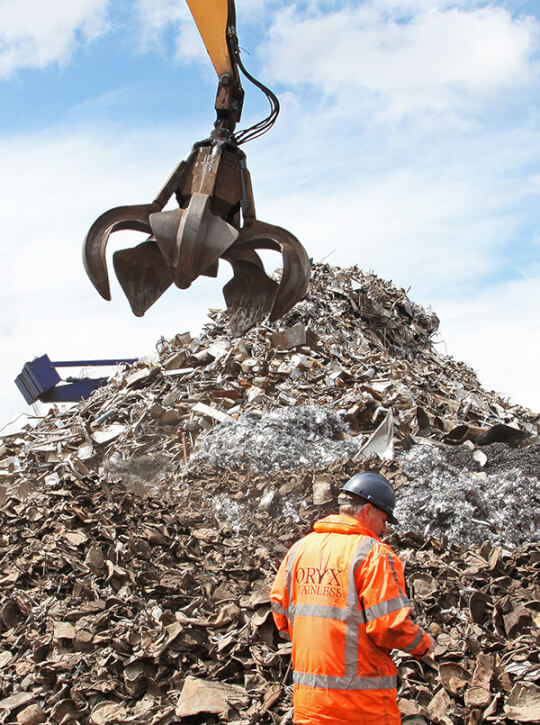
China imposes export controls on steel products
With the continuing economic challenges and the general insecurities, it is not surprising that nickel prices on the London Metal Exchange (LME) are moving somewhat indecisively. Recently there were signals from China that the government could also be satisfied with a growth of 4.5%-5%. Up until recently, the magic growth aim was always communicated as 5%. But immense excess capacities in almost all sectors make it difficult for the Chinese government to ensure a sustainable and profitable growth.
The problem is known, but not yet solved. And even the deepest pockets become too small eventually. This can possibly explain why China recently announced export controls on about 300 steel products which will require authorisation from the 1st January 2026. The export controls could prove to be advantageous for steel producers outside China, different than with rare earths.
After a big correction made by nickel in mid-November down to a level of just over USD 14,300.00/mt, there was a rebound after the 21st November 2025 of up to USD 14,975.00/mt for the 3 months rate. This level could, however, not be held and therefore, nickel is trading at the moment at around the USD 14,600.00/mt level.
Between controls and chaos: Congo’s attempt to steer the cobalt market
The Democratic Republic of the Congo, origin of about 70% of worldwide cobalt mining output, has been trying for almost a year to bring the cobalt market stronger under control – yet the intervention threatens to create a renewed phase of more pronounced price swings. Since the export stop in February and then the quota system introduced in October the global supply stream has dried up for the time being: Producers are still waiting for approval from the regulatory authority ARECOMS. For the market this has meant a drastic reduction in supply of such a critical metal and commodity, for example in battery production.
The price reaction shows how very dependent the market is on Congo’s ability to deliver. Spot cobalt on the CME (Chicago Mercantile Exchange) has risen from 10 to 26 $/lb since February, cobalt-hydroxide even from 6 to 23 $/lb. Yet the price increase, driven by shortages, has a problematic undertone. The shortfall is becoming more serious because transport to China – where the material is further processed into sulphate – lasts up to four months. Even with an immediate resumption of exports, additional quantities would only arrive by the end of the first quarter of 2026 with the Chinese processors. In the meantime, warehouse stocks are being depleted –and this with export quotas already halved for the next two years.
In addition, only a few Chinese plants have environmental permits to be able to smelt cobalt into sulphate when needed. The possibility of easing the shortages through alternative processing routes therefore remains limited. Analysts are warning of a scenario which goes beyond a short-term squeeze situation: A severe supply shortage could trigger a renewed boom-bust cycle – exactly what the Congo is trying to avoid with its market controls.
This timing could hardly come at any worse time. The battery industry is going through a rapid transition to LFP chemistry, where cobalt does not play any role. Chinese producers are continuing to reduce their cobalt intensity in NMC batteries. New vehicles in September were on average built with 6% less cobalt, falling to 2.2 kg per vehicle. This has led to the market’s dependence on the Congo’s export policy to diminish – but at the same time that part of the market which still relies on cobalt will remain susceptible to delivery interruptions.
Against this background one comprehensive question takes on more importance: How can battery producers become more resilient? One answer which increasing becomes more important in several commodity chains – and also shows parallels to the nickel market in Indonesia – is: More recycling, less dependence on single primary producers.
Nickel in Indonesia – How China’s “country within a country” is inflating the market and pushing down prices
Today, Indonesia dominates the global nickel market – with a mining share of about 70 %, similar to the market share of Congo’s cobalt. Yet the remarkable rise in this country is at core, the result of another player: China, which financed, built and today controls Indonesia’s processing capacities. In the meantime, many people speak about a “country within a country”, for the biggest part of Indonesia’s value chain is operated by Chinese companies. Yet the dependence works both ways – and that is exactly where the problem begins.
Whilst Indonesia wanted to make a rapid expansion in its nickel industry turning it into a global hub for battery raw materials, nickel in China’s electric vehicle industry is losing massively in importance. LFP batteries, which use neither nickel nor cobalt, are winning a share of the market and becoming more technologically competitive. The result: China’s processors have no buyers anymore for nickel intermediate products. A growing part of production is now flowing into LME warehouses and not into batteries. Warehouse stocks have risen from 54,000 mt at the beginning of 2023 to 366,000 mt. The recognised LME brands from Chinese producers in the meantime account for 70% of LME warrants.
The structural surplus production is pushing prices in the direction of the cost floor limit and, depending on producers, even further. LME nickel fell in November to 14,330 $/mt – a level that the Macquarie Bank analysts see as being close to the global “floor” of 15,000 $/mt. And yet Indonesia’s capacities continue to grow, pushed by Chinese operators. Macquarie expects another million tonnes of HPAL capacity by 2030 – a scenario which would mean five more years of global surplus supply.
It has to be asked what economic calculation the Chinese government and companies use for this unsustainable course of action. But regardless of which sector, whether photovoltaics, steel, cars, China can obviously do not other than to invest in considerable overcapacities, against market needs, and then to try to export excess production from underutilised facilities at dumping prices to other countries. This has to be resisted, and it also does not seem an especially intelligent option to become greatly dependent on such partners for supply chains of raw materials and semi-finished products.
Indonesia also finds itself in a paradox position: The country wanted to drive forward its own industrialisation with resource nationalism, but is now economically heavily dependent on China’s nickel strategy – a strategy which is clearly tied to the electric vehicle boom. At the same time, buyers, such as Europe and the USA are becoming more and more focussed on tougher environmental criteria while Indonesia’s production is still in the main part carbon based.
The development shows parallels to Congo’s cobalt sector: If dominant supplier countries control or strongly increase market volumes, then the risks of price distortions and strategic dependence increase for buyers. For western producers there remains, therefore, one option, which is becoming more and more attractive: Recycling, which offers supply security and fulfils ESG requirements, and takes pressure off the concentration of raw material powers.
Raw materials from the depths: Trump’s offensive meets German restraint
Already in spring of this year US-President Donald Trump had signed an Executive Order to accelerate the promotion of deep-sea mining. The aim is to significantly reduce the dependence of the USA on foreign suppliers of scarce materials such as nickel, copper, cobalt and manganese – all metals which are indispensable for key industries such as electric mobility and renewable energies. The mining of so-called polymetallic nodules on the ocean floor is central to this. These “potato-shaped” concretions, especially in the Clarion-Clipperton zone in the Pacific Ocean contain large amounts of these strategically important metals.
Our Commodity News edition of August 2023 already referred to the long history of deep-sea mining – first explorations go back to the 1960’s. Even Germany, with both its exploration licences belong to active parties in the Pacific and Indian Oceans in regard to these alternate raw material sources. The Clarion-Clipperton zone – the central subject of the present US initiative – was already highlighted in our edition as the most important area of world-wide deep-sea exploration.
The Trump government sees an enormous economic potential in deep-sea mining. An additional GDP of 300 billion US dollars over ten years and about 100,000 new workplaces are forecast. Companies such as The Metals Company are at the ready to be the first to start commercial mining on a grand scale in the oceans.
In contrast to this, Germany, like the whole of the EU, seems quite a lot more reluctant. Even though the importance of critical raw materials is recognised in the security of supply, for example for offshore wind farms or in battery technology, no concrete steps have yet been taken for a commercial exploitation. On the contrary, Germany is focussing on strict regulatory environmental standards in the framework of the International Seabed Authority (ISA) and is involved in the groundwork for the Regional Environmental Management Plans. The legal framework for deep-sea mining is regulated in Germany by the Sea-bed Mining Act.
The ISA has reacted critically to Trump acting alone. Without compliance with the UN Convention on the Law of the Sea (UNCLOS), which the USA has not ratified, diplomatic tensions are bound to arise. The question of whether imported raw materials from the ocean floor are allowed to enter Germany will greatly depend on whether they have been mined in compliance with international environmental and legal standards.
To conclude: While the USA focusses on the acceleration of deep-sea mining, Germany, despite existing licences and historic expertise – remains cautious. The environmental impact, international legalities and social acceptance are of greater focus here than short-term raw material gains.
And this concludes our report for this year. Of course this will continue next year. We hope this has made for enjoyable reading. We would be pleased to hear your feedback. We wish all our readers and their families a Merry Christmas and a Happy New Year. Until the next time, please stay healthy and well.
LME (London Metal Exchange)
| LME Official Close (3 month) | ||||
| December 15, 2025 | ||||
| Nickel (Ni) | Copper (Cu) | Aluminium (Al) | ||
| Official Close 3 Mon. Ask |
14,420.00 USD/mt |
11,735.00 USD/mt |
2,880.50 USD/mt |
|
| LME stocks in mt | ||||
| November 12, 2025 | December 15, 2025 | Delta in mt | Delta in % | |
| Nickel (Ni) | 252,114 | 253,392 | + 1,278 | + 0.51% |
| Copper (Cu) | 136,250 | 165,875 | + 29,625 | + 21.74% |
| Aluminium (Al) | 544,075 | 519,600 | – 24,475 | – 4.50% |